This was the beginning of an exciting day for me. Our group headed out on a bus to the area in central Taiwan known as Sun Moon Lake. It was there we were to work with Tea Master Steve Huang at the TRES/Yuchi Branch to make our very own classic Tung Ting Oolong sometimes known as Amber Oolong. TRES stands for Taiwan Research and Experiment Station. It is a governement run agency to support the tea industry and farming in Taiwan.
Along the way we stopped off to see some tea fields in Minjiem to learn a little more about organic tea farming practices. The organic tea fields were beautiful and surrounded by other plants such as palm trees and pineapple. This was a first for me to see a pineapple farm!
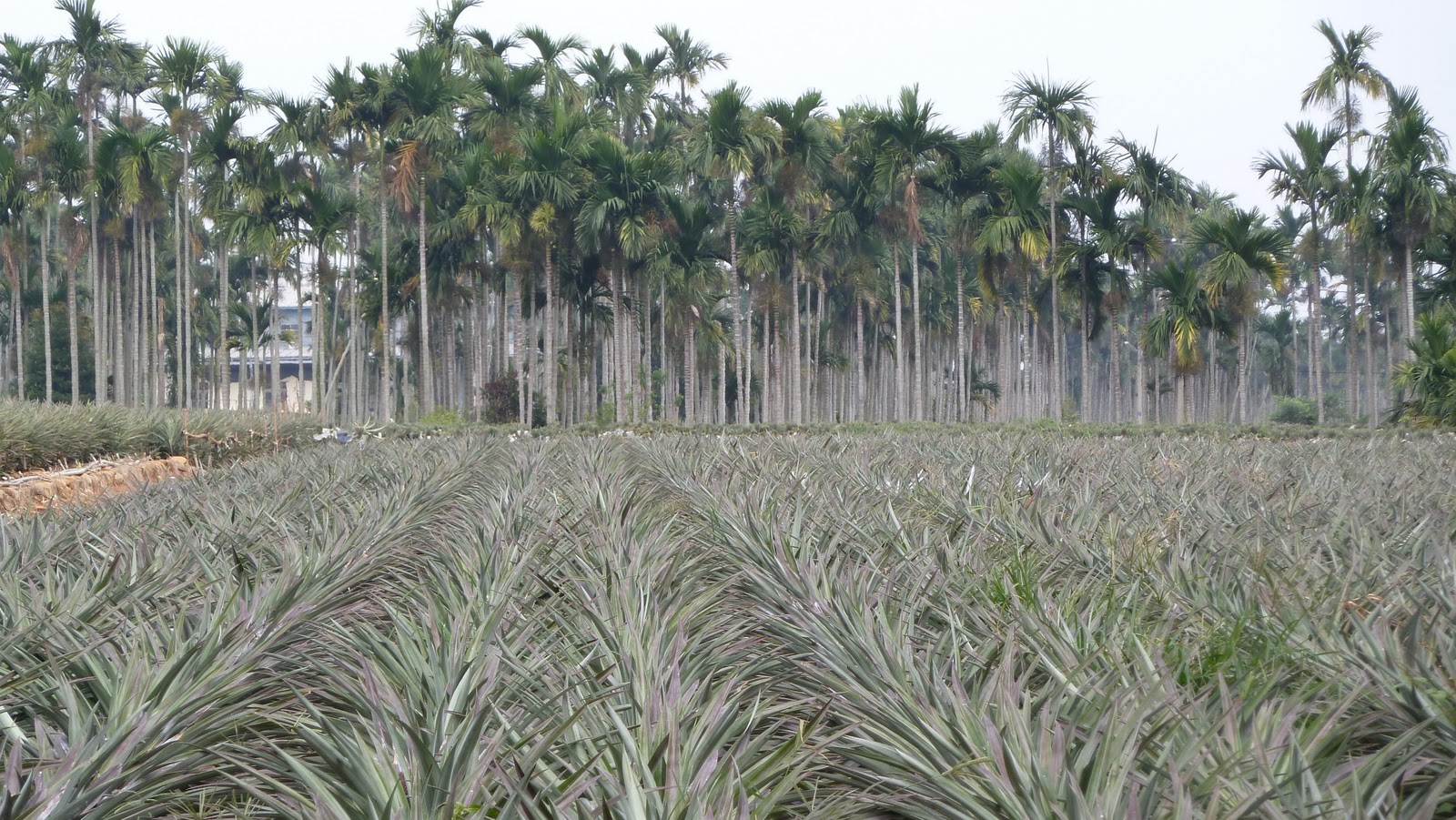

Some of what we saw being used was large plastic sticky yellow cylinders to catch unwanted bugs. This helps to keep the "healthy bugs" alive. The "healthy bugs" are those that kill off the predator bugs that eat the leaves of the tea plants and in organic fields they are one of things used in lieu of pesticides.


Another practice we saw being used is fluorescent lights used at night to keep the bugs at bay.
I learned so much on this trip about how farmers are implementing organic practices into growing tea. I am amazed at the dedication of farmers to give us pesticide-free tea. I had to bid farewell to these tea fields and head on to one of the most exciting adventures of the trip for me. We were off to make tea (below). We exchanged our large bus for three smaller vans to allow us to get around in the mountains. As we approached our destination, we looked out the window at Sun Moon Lake (. It was beautiful and we would see it again from our hotel, but not before our long night of tea making was done.


Here is our Tea Master Steve showing our group how to "fluff."


 During one of our learning sessions, Steve presented each of us with a gift. It is our name written in Chinese down the center with the date to the left and in small letters to the right, "I am happy to make this for you." I took several pictures of it and would love to make a pillow using a photo transfer to remember Steve and my time making tea!
 After the tea was allowed to oxidize for about 3 hours roughly 12 1/2 hours had passed since we had begun working with the tea leaves. It was past midnight when we started the next phase of processing which was panning and drying. To the left is the panning machine.

We pulled up into the TRES which was surrounded by beautiful tea fields seen below.

Then we walked over to the tea leaves that had been plucked for us. They had already started their outdoor solar withering process. These are the leaves that we would spend the next 14 hours working with to process them into tea.

While the leaves were withering outdoors, we had an opportunity to visit a black tea processing plant on the same facility and eat a quick lunch. Then it was off to tend to our tea leaves to bring them in for the indoor withering time.


Upon moving the teas indoors we put them on large baskets and laid them out on racks. The tea leaves would sit for a while and then we would need to go back and "hand fluff the tea" 3 times; each time with a little more intensity.
Here is our Tea Master Steve showing our group how to "fluff."

Then it was up to us to fluff our own. You need to maneuver your basket so all the tea leaves are towards the center. Once the tea leaves are in the middle you then go back and forth with your hands to fluff. This was easier said than done as these baskets are quite large. Below are some pictures of me trying to follow Tea Master Steve's fluffing instructions!


After each fluffing, the tea leaves were allowed to rest on the bamboo baskets on the racks. I wish you could smell how wonderful the room was where we were processing our tea. It reminded me of my days growing up in Florida and walking through orange groves when all the orange blossoms were blooming. It was amazing to me how floral-smelling just leaves can be.

For the fourth and fifth fluffing of the leaves, it would be done in a large bamboo tumbler pictured above. The first time in the tumbler it would be a slower and shorter time. Our Tea Master Steve tells us that he judges how long the tea is in the tumbler based on smell. Then the tea goes back to the bamboo baskets for another rest. The next time it would go into the tumbler it would be double the speed and for a longer period of time. Steve lets us know the time is done with fluffing in the tumbler when the aroma is at its high point and the grassy smell is at its low point. The leaves were then left to oxidize in the bamboo baskets for a time.
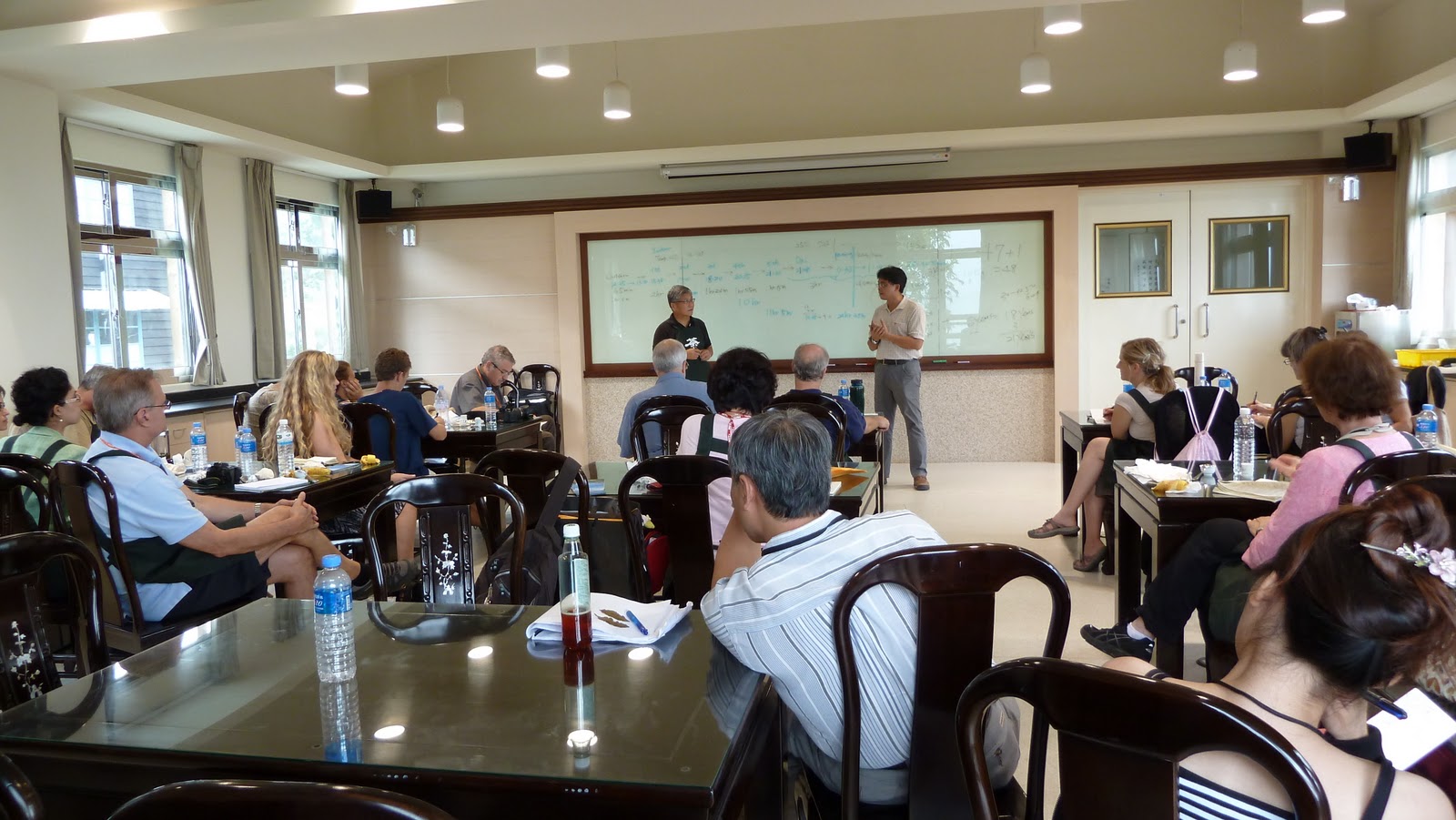
In between each session of processing our tea leaves, we went back to the classroom for more training on tea processing. It was there that we also cupped teas (professional way of tasting teas). I felt honored to be learning from the Head Tea Master in Taiwan. There is a five year wait for farmers to get into the training facility to learn from him! We also were able to sneak in a quick dinner in town during one of our wait times.
 During one of our learning sessions, Steve presented each of us with a gift. It is our name written in Chinese down the center with the date to the left and in small letters to the right, "I am happy to make this for you." I took several pictures of it and would love to make a pillow using a photo transfer to remember Steve and my time making tea!
 After the tea was allowed to oxidize for about 3 hours roughly 12 1/2 hours had passed since we had begun working with the tea leaves. It was past midnight when we started the next phase of processing which was panning and drying. To the left is the panning machine.
  Here are the tea leaves that have come out of the panning machine and are now being rolled. The worker is twisting the lever at the top which adjusts the tension placed on the tea leaves.
After the leaves are done with pan firing they go into the dryer. When the leaves were put into the drying machines, they were still quite clumped up. Here I am below "unclumping" the leaves as they are on the go on the conveyor belt into the drying machine.

We were all so excited to see our leaves come out the of dryer as that meant we were finished for the night. However, we were not finished with the tea, as we would need to come back the next morning for the next steps.

After studying tea for over ten years, working hands-on to actually make oolong tea myself was an amazing experience. Understanding all the leaf goes through physically and chemically, as well as, how much effort is put into it by the tea master, makes me appreciate what is in my cup each day so much more. I was told that by the time a consumer makes a pot of specialty tea,
880 people have handled and put effort into getting it into your cup.
As this post is going up on Thanksgiving week, I thought it would be important to express my gratitude for having the opportunity to go on this trip and for all those that helped put it together, especially Thomas Shu, Josephine Pan, and Jackson Huang. Their dedication to teaching others about tea is unwavering! I hope my blog has helped those of you that love tea like I do, to appreciate all those who work so hard to give you something special to drink everyday.
Did you have any idea the effort it took for you to drink good cup of tea?
On a personal level, I am so grateful to my family, especially my husband Joe, for supporting my career. He encouraged me to go on this trip even though it coincided with our 20-year wedding anniversary. We just celebrated our special day last weekend-one month late, but none the less special!
In my next couple of blogs, I will finish making the tea and then off to the Ali Shan Mountains to show you some of the most beautiful tea fields in the world!
Happy Thanksgiving and Sipping, Lisa


 Posts
Posts