Showing posts with label 2010 Taiwan Oolong Study Tour. Show all posts

Thursday, May 26, 2011

Reflections on my Tea Journey

Upon returning home from my tea trip to Taiwan and Japan and blogging about it all, I am still amazed at the beauty and diversity of each region. However , what impressed me the most about the trip was the people! Everywhere we went, the people were so gracious to our group. We were greeted so warmly and all seemed to want to share their knowledge of tea with us. Many of them bestowed gifts of tea to us just for stopping by and listening! As I steep the teas that were given to us or the teas I purchased from places we visited, my appreciation of what is in my cup grows so much more.


I thought it to be such an honor to be in the presence of such educated tea individuals and yet they always seemed honored by our presence as well. The patience given to our group of Tea Master Steve as he taught us how to make oolong tea was impressive. The process of making my own tea was also very high on my list!


Getting to meet the farmers who put their effort into giving me a wonderful cup of tea, makes each infusion so much sweeter. Now as I drink the tea, I remember from where it came and who made it taste so special. Tea Master Steve and one of the farmers pictured here traveled several hours through the mountains to come to our graduation ceremony in Taiwan before we left for Japan.

I have to admit after hearing stories, I was somewhat apprehensive about traveling to Asia before I left . I had heard about the dangers of drinking the water and getting sick from the food. To be quite honest, the eastern-style bathrooms even made me a bit nervous! The culture in Taiwan and Japan are definitely different than here in the USA, but I would go back again without any hesitation and hope to very soon.

Thank you to all who put in their time to make our trip so educational, especially the hosts for our trip Thomas Shu and Josephine Pan.  If you are interested in going this year, registration will begin soon.  I will cherish my time that I was there and will remember (or try to) what I learned.


If you ever have the chance to go Taiwan and Japan and learn more about the culture, tea, and beauty of each country, I highly encourage to do it.  In the June blogs, I am going to get personal and we will also talk about National Iced Tea Month!  If your curious, you want want to miss it!!

Happy Sipping and Fondly Remembering the People of Taiwan and Japan, Lisa

Friday, May 13, 2011

Day 3 Part 2 O-Cha (Tea) Festival & Closing Traditional Japanese Dinner


After my lovely visit to the garden and temple, our group was off to the World O-Cha (Tea) Festival 2010.  This festival is only held once every three years.  It was a conglomerate of tea buyers and sellers from all over the world.  It was fun to be a part of such a global tea experience.  Here is the entrance to the festival with people rushing about anxious to see this year's teas and new products. 


I found this wall of art interesting.  Our host, Thomas Shu, graciously explained what it was.  All the symbols are done in calligraphy in Hanji (Chinese symbols) except for the one just to the left of my head which is in Japanese.  They all say TEA.  Although they all say the same thing, each one held its own beauty and looked so harmonious together.  According to Thomas, harmony is a fundamental practice in the Asian culture.  Harmony is also the spirit of tea.  
Along with tea vendors there were other vendors selling many different kinds of teaware, books, pottery, etc.  I found these cast iron kettles really beautiful. When I looked at the price and did my quick Yen to Dollar comparison, I understood why I found them beautiful!  They were out of my price range so instead of buying one, I took a picture so we all could enjoy their beauty!


Along with vendors, there were demonstrations being held.  Here is a man showing the old fashion way to make matcha.  He had volunteers come up and demonstrate and most of them left out of breath.  It is now done by automation, but the same practice of grinding the tea leaves on large stones is still done.   


Different tea ceremonies were held in front of the large tea calligraphy wall.  I was honored to be asked to be a part of a Chinese oolong ceremony with this young woman.  I was thrilled to be a part of it. 


I did feel sorry for the outside vendors because of the rain, not many were visiting them.  I ventured out for some lunch and shopped all the while trying to avoid the large puddles.  I found a lovely little pottery piece in the shape of tea leaf with blue and white flowers on it.  It is the perfect container for my vitamins I take throughout the day. 
At the close of the day, our group met with the directors of the festival.  I hope to return again to this festival in three years!

Hello Lisa:
JP and I have a very busy weekend in Chicago over the weekend.
One tea workshop at Northwestern U and one at Chicago's TAAGCC...both are full house events.  Tiresome but very excited.
Please see the photo and let me know whether this is what you are looking for?

Our group loaded back on the bus, one last time to our final meal together.  We drove to a small seaside town that was know for its fresh off the boat sushi and sashimi.  We all were asked to take off our shoes and to sit on cushions on the floor.  A few day prior, we were asked to choose from a variety of menus that all sounded delicious.  The "A A" place card next the tray of food was what I choose and I couldn't have been happier.  Can you guess what might be in the wooden jewelry box looking item?

In the upper left corner, I had the freshest sashimi, in the upper right side was some tempura, in the center bottom was a soup called chawan mushi that had seafood, short necked clams, and ginger, and the surprise in the wooden box was why I chose this meal.  It was broiled eel over a bed of rice.  I hadn't ever had eel  before and I wasn't disappointed.  It was delicious as was the whole meal. 


The dinner was a wonderful way to close the trip.  I feel so blessed to have gone to Japan and hope you have enjoying following my journey in tea!  In the next blog, I will share some of my reflections about the trip along with some cultural differences I found interesting. 

Happy Sipping, Lisa

Thursday, May 5, 2011

Day 3 Japanese Tea House and Temple

Today was a rainy day, but I decided to venture out in the morning before going to the O-Cha (Tea) Festival.  Since I have been traveling with a group, it was nice to take a walk by myself.  It was really the first opportunity I had the whole trip to be alone.  One of the members in our group told us about a temple behind our hotel that she could see from her window in her room.  On my journey, I stumbled upon this small teahouse just behind the hotel.  Although it wasn't open, I could just imagine the tea ceremonies that have taken place there through the years, can't you?


My journey then took me to a very interesting site and my emotions took me off guard.  Although I didn't enter through these big heavy wooden gates, I just thought the entrance was so inviting.  The roof over the doors was so ornate.  My husband is a builder, so I am always interested in how things how built and the work that is involved. 
What was so fascinating about this temple is that is it was preserved down through history.  As you can see, it is surrounded by a city that was built around it and yet the temple and the beautiful zen garden remained intact or so I thought.  Although I was in a city full of tall buildings and not far from a major train station, the gardens remained peaceful.


Below you can see the carpet of stone that has been manicured so nicely with even rows and sculptural rocks and plants to accent the rock carpet. 


Everything was kept so nicely as to show respect for each part of the garden as an individual place.  However, I kept wondering why I had this sense of sadness walking though the garden.  


Even the raindrops landing in the pond added to the serenity of the garden in a unique way.  The place held such beauty, that I desired to know more.  I wondered if I may be allowed to enter the temple. The picture below shows the temple beyond the pond.  I went through the doors and there was a kind gentleman with a jacket on that had a "Georgia" emblem on it.  I thought great, we have something in common, he has a jacket from my home state!  He spoke some English and  told me that his son was in Georgia and worked for Coke.  It is a small world, isn't it? 


He allowed me to walk around inside the building. It was lovely inside although it didn't appear that old. He told me that the temple was rebuilt, but that the original one and the gardens were over 600 years old. Here is a view from inside the temple out to a lovely courtyard.  I longed to know more about this place that had not been taken over by city buildings. 
On the side of the garden and temple is a cemetery.  It is evident that loved ones still come visit the ones they have lost. 


Upon my return, I wanted to find out more about its history. Our host's daughter and interpreter for the trip, Kazuko found out more information for me through her father. He actually went over to the temple especially for me to find out more! The building is Buddhist temple named Hodaiji. The original temple used be be very large and was built in 1381. During the edo period (1600-1850) the Joseon mission came from Korea and stayed there on their way to Tokyo. They were duly impressed by its beauty and architecture. 


The building was completely destroyed by an aerial bombing during World War II in 1944.  It has since been rebuilt on the site, but much smaller in scale.  There are 40 small stone figures throughout the garden.  They are placed in the memory of the spirits of the dead children that were lost. 

I was moved by this story and I think that explained some of my sadness through all the tranquility I felt while walking through the garden.  If you are ever in the land of tea in Shizuoka, be sure to take time to walk through this beautiful garden. 

Happy Sipping and Serenity, Lisa

Thursday, April 21, 2011

Day 2 Part 2 Food in Japan & Hojicha Processing

Oh, the food in Japan is something to be desired!  Before I move on to the factory, I thought you might be interested in our lunch that was served at the tea auction facility.  As a big foodie, I couldn't skip our lunch presentation for you.  This is the Japanese version of a boxed lunch!

Inside the box was some riced topped with various kinds of delicious sushi and sashimi along with a small bottle of soy sauce and wasabi.  It was so yummy and the perfect lunch to gear us up for the next part of the day! 


After lunch we headed out to the hojicha factory.  (Reminder of what hojicha is.) As the bus pulled up and we all climbed out, you could smell this lovely roasting aroma permeating the air.  Once again were asked to put on hairnets and take off our shoes and put on slippers for sanitary purposes.  Although the look isn't the most attractive, I appreciate the effort for cleanliness. 

As we toured to facility, the smell was intoxicating.  We watched how the tea is taken through to finalize it. Since most everything is done by machines, there were only two workers inside this plant working.  You can again see the high sanitary level of the workers.  The workers had to wear gloves as well.  The mask is not just for sanitary purposes, but also so she doesn't breath in all the hojicha dust. 

Below you can see how the back wall of this bin is covered in tea and beside it are large bags of tea ready to go to market.


After our tour of the plant, we headed off to a wholesale company selling teapots and teacups.  Our day wrapped up with dinner on our own again.  The first night out, we discovered this Thai restaurant called Colonial Kitchen so a group of us decided to venture out to try it.  We were very fortunate to find an English speaking waiter.  He was excited to practice his English too so it worked out well for everyone! 
Can you tell we are tea people? With all the tea on the table, we had a hard time finding room for our plates.  I loved the way they served tea in this restaurant, don't you? 

In this picture is: Far back from left to right, Elise Scott of Pearl Fine Teas, Ken Rudee of Barnes and Watson Fine Teas, and Judith Krall-Russo of Tea Food History . In the front row is Newman Johnston of Teas Etc. and Lynayn Mielke of East-West Tea Emporium.


  Here's a toast to you as you follow me on my journey to day three where we will discover a lovely historic Japanese teahouse, temple, and the big O-Cha (Tea) Festival!

Happy Sipping, Lisa

Wednesday, April 13, 2011

Day 2 Japanese Tea Processing & Shizouka Tea Auction

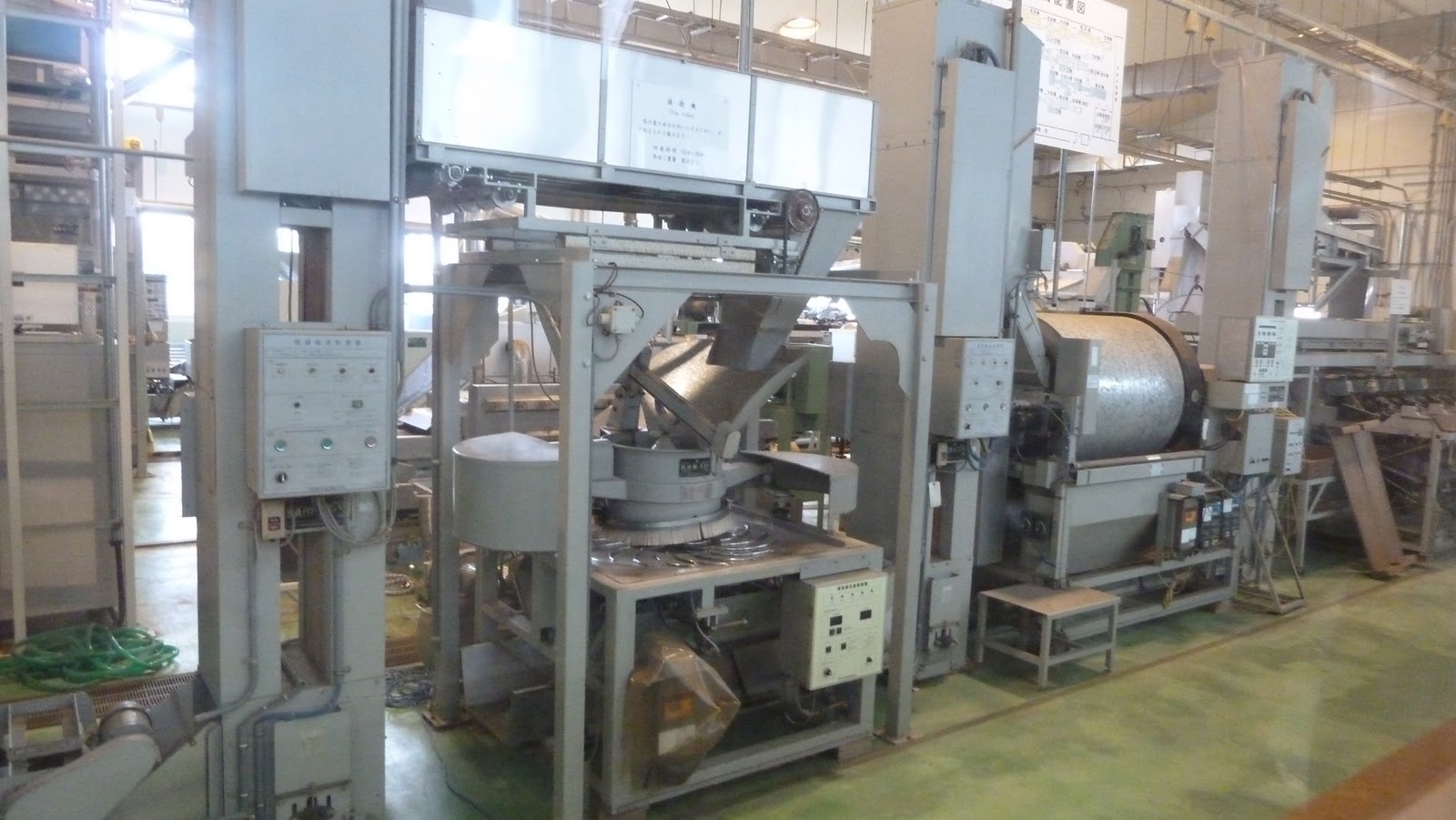
Looking good in a hairnet, wouldn't you say?  Today we headed to a tea refinery plant. This is where the aracha is taken for final drying, sorting, and blending.  Again all of this is done by machine.  Our group was asked to wear hairnets (interesting look for all), take off our shoes, and put on slippers to keep the facility clean.  Here I am holding the finished tea-Sencha after final processing. 
We were allowed to peer through large glass windows on the second floor at the processing center below.
 

It was quite impressive all the machinery used for final processing.
 

From there we left to go to the Shizuoka Tea Ichiba Tea Market which is where over 200 companies come to bid on about 1,500 kinds of tea in one day. 


We watched a film of the auction process.  When the doors are open to the buyers, there is a huge stampede to the auction tables to start cupping and bidding.  It reminded me of videos you have seen on TV on Black Friday as the eager shoppers rush through the doors to get a great deal!  After the film the men in charge so kindly explained the bidding process to us. 


Each hat color represents a different position: the man in the yellow hat represents the broker, the man in the green hat represents the seller, and the man in the blue hat represents the buyer.


The tea is weighed out for cupping (professional way of tasting teas) using a scale and Japanese coins as the counter weight.  The broker uses an abacus to tell the seller what price the buyer is willing to purchase the tea for. It was amazing to watch how quickly they moved the wooden pieces around on the abacus to calculate the price.   The seller then decides if that price is good or he wants to negotiate further.  The bidding stops when the parties all agree to the price.


Instead of shaking hands to seal up a business deal, all the men clap three times in unison and the deal is done!  After the film and demonstration, our group was in store for a treat.  Mr. Yamanashi, our host and man in the blue hat, had prepared for us to do a special cupping of his teas.
 

We headed down to the auction room where rows of stainless steel-topped tables lined the room.  It was exciting to be in the same place where teas were sold.  We had the opportunity to see and cup side-by-side different quality levels of the same tea to compare the difference.  I always love to compare different qualities of the same tea side-by-side.  Your palate can really tell the difference if you do it this way. 
Some of the biggest part of tasting is actually smelling.  Here you can see, we not only smell the dry leaf, but the wet leaf as well.  The leaves will speak to you as to their quality and freshness. 
 

How honored I was to meet and talk with these men in the Japanese tea industry.  To my immediate right is Mr. Yamanashi, our host and President of Yamaichi Trading Company. To his right is his Taiwan friend Jackson Huang who arranged the Japanese portion of the trip for us. To my immediate left is Mr. Enomoto who is a partner with Mr. Yamanashi.  To his left is Mr. Katsutaro who is now retired, but was an expert instructor on how to harvest and machine process tea.

Mr. Yamanashi was so kind  to give all of us a big bag of samples of 10 different kinds of tea in varying grades.  There was a friendly rival between he and Jackson Huang.  He told me laughing in his best English after he gave me my samples, "I am the best host" while pointing over to his friend Jackson.  It was funny to watch these old friends kid with each other!   I kiddingly agreed with Mr. Yamanashi that he was "the very best host indeed." 

Stay with me for part 2 of this wonderful day.  I will show you a hojicha roasting facility and take you to a Thai dinner with my fellow tea friends. 

Happy Sipping and Still Trying to Figure out how an Abacus Works, Lisa

Thursday, March 10, 2011

Day 1 Shizouka-Heart of Japanese Tea with Touch of France

The day started great with breakfast at the hotel.  I have to say that the crescent served was one of the best I have ever tasted!  Who knew you would find a delicious crescent in Japan? After breakfast, we loaded up in our bus and headed to the tea fields.  Shizouka is the largest tea growing region in Japan.  It grows and produces roughly 60% of the teas for the nation.  I was so excited to start exploring the region and tea production.
 
Our first stop was Shizuoka Tea Experiment Station.  It has a small experimental tea farm and processing plant.  Almost all tea is machine harvested in Japan.  They either use a machine similar to this or a hand held device that is like a rounded hedge trimmer that is held by two workers on either side of the rows of plants.  This machine is nice, because it not only cuts the leaf, but also gathers the leaves into large white bags. 


Most farmers co-op with a factory to send their leaves for processing.  Tea is processed differently in Japan than in Taiwan.  Almost all the tea that comes out of Japan is green and is machine cut and processed.  It also has a two step processing procedure.

In order to stop the oxidation of the leaves and allow them to stay green, the leaves are steamed.  Then the tea leaves are sent to several different rolling machines while some of the moisture is being reduced.  It is then sent to a final drying machine.  At this point, the tea is a raw form called aracha. The aracha tea is then sent to a separate factory for further final processing.   We will visit that on day two of our tea trip. 


After a great morning of studying tea harvesting and processing, we got back in the bus and headed for lunch.  As we pulled into the parking lot to our restaurant, it looked like we could have been in France.  This lovely little cafe was so inviting! The name was Frutta Fresca - Tarte and Quiche.


We knew we were in Japan though because as soon as we sat down, we were brought some green tea!  I just loved the pottery that it was served in, don't you?

The chef was apparently trained in France and has tried to bring back a touch of it to her home country.  We all thought she had done a fabulous job.  Her garden in the back of the restaurant was surrounded by hills with tea gardens on them .  Along side the restaurant was a railroad track that had a steam engine train pass by as we ate.  The surroundings couldn't have been any more perfect and the day was just beautiful!


Our table ordered 4 things and we ate family style to try all the delicious food.  The groups favorite was the salad that was so fresh from her garden.  This was truly a farm to table experience for us as we sipped tea grown right in the area and ate the delicious salad that came from her garden out back!


Some of us purchased a dessert to go from her bakery.  I got a chocolate torte and had it for dessert that evening in my room with a cup of tea.  The chef and her staff were all so friendly.  They even came out to wave bye to our bus as we headed to our next stop.  Our group had been so well received in Taiwan and now in Japan as well.  It was an added bonus to know the people of Taiwan and Japan are so welcoming to foreigners. 


Tea is such a universal bridge to new friendships.  I am blessed to be in such a wonderful industry.  In my next blog, I will take you to the tea fields of Shizouka and introduce you to more lovely people!  What's in your cup today?

Happy Sipping and Remembering, Lisa